
Blessed Are Those Who Need God
Ronald Ayala
Home
Sermons - Fe Unida
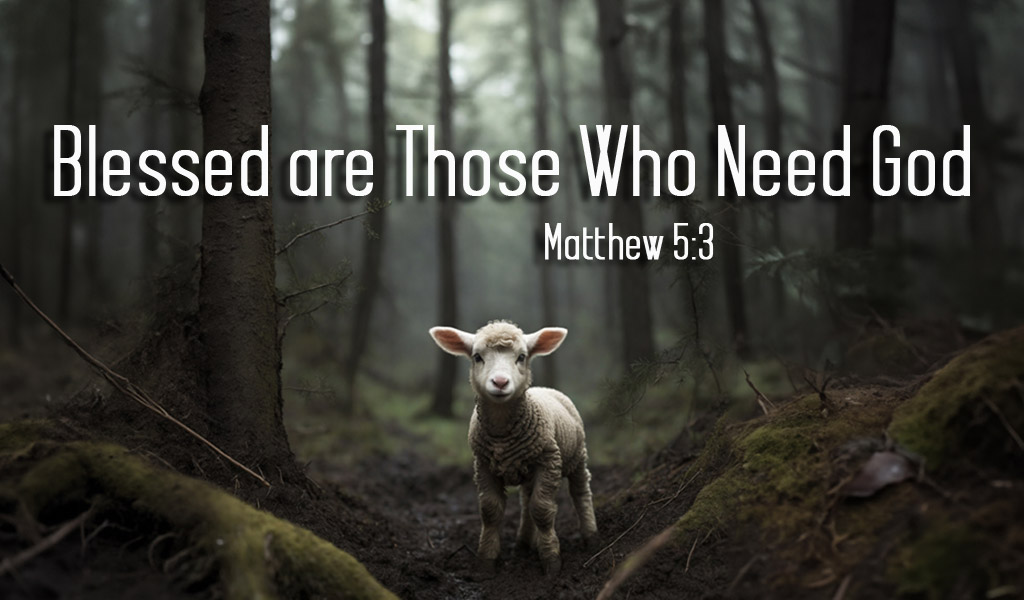
Matthew 5:3 (NIV)
“Blessed are the poor in spirit, for theirs is the kingdom of heaven."
Isaiah 66:1-2 (NIV)
This is what the Lord says: “Heaven is my throne, and the earth is my footstool. Where is the house you will build for me? Where will my resting place be? Has not my hand made all these things, and so they came into being? "declares the Lord. “These are the ones I look on with favor: those who are humble and contrite in spirit, and who tremble at my word."
Psalms 51:17 (NIV)
You do not delight in sacrifice, or I would bring it; you do not take pleasure in burnt offerings. My sacrifice, O God, is a broken spirit; a broken and contrite heart you, God, will not despise.
Psalms 23:1-3 (NIV)
The Lord is my shepherd, I lack nothing. He makes me lie down in green pastures, He leads me beside quiet waters, He refreshes my soul. He guides me along the right paths for his name’s sake.
Matthew 5:3 (NLT)
“God blesses those who are poor and realize their need for him, for the Kingdom of Heaven is theirs."
Sermon Text
Blessed Are Those Who Need God
Sermon preached by Ronald Ayala Iglesia Fe Unida - (United Faith Church in Nueva Suyapa, Honduras)
God bless you, brothers and sisters! It is good to be in the house of the Lord where we can meet Him together. Amen. The Lord is speaking in these days because He is good—because He is coming, church! He is already coming, and He is speaking clearly to His church. For recent weeks, He has been teaching us about the power of the Gospel. Not what we believe the Gospel to be, but the true Gospel as Jesus described it when people asked Him, “Jesus, how are we going to inherit the kingdom of heaven?”
You know, the messages Jesus preached aren't often heard today. That is because people are pursuing their own interests; everyone is focused on themselves, seeking their own goals and objectives in life. Even from the pulpits, we hear messages about how to achieve our personal dreams. I believe that, even unconsciously, when we chase these goals, what we are really reaching for is happiness. We want to obtain some form of joy. The world tells us, “Look, happiness is this,” or “Money buys happiness.” There is even a saying: “Money doesn’t buy happiness, but I’d still be happier if I had it.” But we are in a season where the Word of the Lord is coming to correct us. Even though we call ourselves Christians, we still go around chasing the things of the world. We still want to experience happiness through what society offers—that you have to "enjoy life" or "go out" to be fulfilled.
But Jesus sat down with His disciples and explained what the Kingdom of Heaven was really like. He showed them what He expected of them until the day of His coming: the character, the personality, and the standard of morality that must define His followers. We find this in the Sermon on the Mount.
The Sermon on the Mount begins with something truly incredible. While Jesus is outlining His expectations, He isn't adding new "rules" to the law; He is simply interpreting the law correctly. He is revealing what the law truly meant. Often, we leave church, read the Bible, and think, “Oh, they’re telling me I have to do this,” or “Jesus says I have to give this up,” and it feels like a heavy burden. We think, “I can’t do this.” But do you know how the Sermon on the Mount begins? It begins with the Beatitudes. It begins with blessings. That is how Jesus starts His message.
“Beatitude” means blessed, fortunate, or happy—truly happy. The disciples must have thought, “Wow, how many times have we searched for happiness, only to find the Lord has left the secret in His Word?” The Beatitudes are not a requirement; they are a blessing. It is as if Jesus is saying, “Friends, you have spent your whole life chasing this—look, do this, and you will see how happy you will be.” This is what the Sermon on the Mount is all about.
The Lord has been speaking to my heart through this first characteristic, because while every Beatitude has a future reward, this first one has a reward for today. You and I can enjoy it right now. Let’s look at Matthew 5:3. We sang about this today—how good is the Lord! Our sister was right to encourage us to rejoice, but you know what, church? You can’t simply encourage someone without giving them a reason. We are going to find that reason, and we will see how beautiful the Word is as it fights against the devil’s lies. Amen! Give the Lord a round of applause.
If you have taken the trouble to come here today, say, “Lord, wake me up! I want to be free!” We often come to the house of the Lord full of darkness, but in the name of Jesus, today that lie falls. It falls! Matthew 5:3 says: “Blessed are the poor in spirit, for theirs is the Kingdom of Heaven.”
Blessed are the poor? Happy are the poor? I imagine the people of that time were confused. Does it mean those who have nothing or lack everything? A common dictionary says a poor person lacks resources, is helpless, and cannot fend for themselves. But the Bible isn't talking about material poverty or economic status. It isn't saying that those who have no money are automatically happy. It also isn't referring to those who lack enthusiasm or energy. He is talking about the "poor in spirit."
The word "spirit" here is lowercase because He isn't talking about the Holy Spirit; He is talking about the spirit of man—that breath of life God gave to Adam. That spirit in each of us has been damaged by sin and needs to reconnect to God. That is the spirit that must be "poor."
No matter how much we sing and celebrate—and all the songs today were about being joyful—if there is no happiness here in the heart, it isn't real. There might be a little movement, a little emotion today, but happiness is not an emotion; it is something that resides deep in the heart. As we discussed last week, happiness doesn’t depend on circumstances—circumstances only reveal what is already there. If there is happiness in the heart, it doesn't matter what is happening around you.
What does it mean to be poor in spirit? Take this with you: we need to understand this and say, "I want to be that," because there are people in churches who aren't happy. When they get home and look around, they cry. It’s not wrong to cry, but the foundation of their heart isn't joy. No matter how many hymns they sing, there is a barrier, a bondage, a heaviness. They say, "I wish I could rejoice," but they feel they can't.
Let’s look at Isaiah 66 to find the answer. Isaiah 66:1-2 says: “Heaven is my throne, and the earth is my footstool... Has not my hand made all these things?... These are the ones I look on with favor: those who are humble and contrite in spirit, and who tremble at my Word.” The King James Version says the "poor and contrite in spirit." Look at what the Lord is saying: "Everything is Mine! What can you bring Me? What house can you build for Me? The very land you stand on belongs to Me." But there is one thing God values: He cares for the poor and those with a contrite spirit. He looks for the humble who tremble before His Word.
The "poor in spirit" are those who recognize they lack spiritual resources and are completely dependent on God for everything. When we are spiritually poor, we acknowledge that we are not self-reliant. It is the person who says, “I don't have the resources to change my family, God. I can't do it myself. I'm too 'poor' to raise my children; I don't know how. It’s not that I don't have money—I just don't have the wisdom. But You can teach me.” The one who recognizes they need God for every single thing in their life—that humble person is the one who is poor in spirit.
The Lord is saying, "I care for the humble." Poverty of spirit is reflected in our humility before God. David understood the secret of having a broken spirit and depending on the Lord for all things. Many times, we don't truly understand this until we lose something. You see, when the Lord begins to bless us—when we have a job, a family, and everything is going well—we often begin to depend on those blessings. We start to trust in those things. There is nothing wrong with enjoying the blessings God gives us, but when we start to depend on them for our identity, God has to teach us a lesson.
How do we know we’ve started depending on things instead of God? We know when God takes them away—and our happiness goes right along with them. In those moments, we are forced to admit: "I wasn’t depending on God; I was depending on that person, that job, or that money." We tell ourselves we can't be happy now that they are gone. But the Lord says, "You will find true happiness only when you depend on Me."
"But the Lord says, 'You will find true happiness only when you depend on Me.'"
Many people today are preaching that God exists to make you prosperous—and people believe happiness lies in those riches. But the Bible says that if you learn to depend on Him, that is where you find joy. The older generations understood this better than we do. They used to talk about how, when they were young and started a life together, they had nothing—maybe just a cot or a rug—but they were happy because they had each other. Their happiness didn't depend on "stuff." Today, we act like happiness depends on everything around us. The Lord is calling us back to the humility that comes with poverty of spirit.
In Psalm 51, David says: "You do not delight in sacrifice, or I would bring it... My sacrifice, O God, is a broken spirit; a broken and contrite heart You, God, will not despise." David understood there was something higher than ritual, something better than religious offerings: a heart that knows it has failed the Lord. A heart that recognizes its own weakness and understands it cannot live a single day without God—that is the sacrifice that pleases Him. To be poor in spirit is to lose confidence in your own strength and recognize that you depend entirely on Christ and the Holy Spirit. David, a King who had everything, said, "Lord, none of my wealth pleases You. What pleases You is when I come with a broken heart."
Do you remember the parable of the Pharisee and the tax collector? The Pharisee stood and bragged, "Lord, I thank You that I'm not a sinner like that man! I fast, I tithe, I do everything right." But the other man knelt, unable to even lift his eyes to heaven, and cried, "Lord, forgive me, for I am a sinner." Jesus asked: "Who left there forgiven?" It wasn't the one boasting about his resume. It’s not that doing good is bad, but your attitude is everything. Some of us are always talking about our spiritual achievements—"I did this, I fasted for that." It’s okay to give a testimony, but there comes a point where we must admit that without God, we can do absolutely nothing.
That word "contrite" in Isaiah and the Psalms—don't just gloss over it. It means wounded, crushed, shattered, or dejected. How does the Lord want you to come to Him? With your chest puffed out? No. He wants you surrendered. Shattered. What good is it to "bring" something to God if you don't bring a broken spirit? This week, the Word told us: Do not deceive yourselves. You must practice what you hear. And the Lord is saying the most important practice is coming to His house with a broken spirit. Without that, everything else is worthless.
What are you bringing to the Lord today? We ask that often. Are you bringing praise? Listen—God doesn't need your praise. He has millions of angels who prostrate themselves 24 hours a day, crying, "Holy, Holy, Holy!" And yet we, wicked human beings, walk into the house of the Lord with arrogance, saying, "I don't feel like it today, Lord. I’m not in the mood." That is just flesh and sin talking. Where is the spirit of the broken man? It isn't about the songs, the raised hands, or the outward show; it is about a needy, humble spirit.
I’ve seen this when we go out to help those in need with food or clothing. Sometimes, the very people who have nothing act with pride; they despise the help and ask, "Is this all you brought?" It breaks my heart. But how must the Lord look at us? We say with our mouths that God is the only one who can help us, heal us, and save us—yet we come before Him with proud hearts. Isn't it contradictory? If we truly believed He was our only hope, we would be prostrate before Him, pouring out everything. But we let pride get in the way.
David knew that trying to please God through outward actions was useless because God looks at the intent. He doesn't just look at what you do; He looks at why you are doing it. How did you come to God's house today? Was it just another ordinary day? When the things of God start to become ordinary, your life will become ordinary. You can have all the money in the world, but without this poverty of spirit, you will never find true happiness.
"When the things of God start to become ordinary, your life will become ordinary."
True happiness only comes from the Heavenly Father who created all things. He says to us, “You are happy when you need Me, because I will answer you—I will indeed answer you.” But when we start to view the things of God as ordinary—just another service, just another song, or "I don't feel like it today"—that is exactly what our lives become: ordinary. People are constantly searching for the extraordinary and the supernatural; they cry out, "God, move! We want to see Your power!" But David understood the secret: I will go to His house with a broken heart. The reality is that many of us already have hearts that are shattered, mutilated, or damaged. God is pleased with that humble heart. When you do things from that place of humility, your life becomes a pleasing offering to the Lord.
One commentator says that a sacrifice to God is a broken spirit. This isn’t a trivial matter; it is profound. It isn’t about breaking into despair, but about self-humiliation—detesting sin and surrendering in obedience to the Word of God. Humility is what draws us closer to Him. Paul tells us in Philippians 2 that Christ emptied Himself of everything. Even though He was God, He didn't grasp at that equality; He emptied Himself of His glory to become like us. Why? To depend totally on the Father.
Christ was humble because He depended entirely on the Father. Even on Calvary, He asked, “Father, what are we doing here? Is there another way?” Jesus, the Son of God, could have called down legions of angels to stop the pain, but instead, He asked, “What do we do?” The Father said, “You have to go to the cross,” and Jesus obeyed. On that cross, He said, “It is finished.” That is true humility. It isn't the false humility of wearing dirty clothes or walking with a bowed head. It isn’t the false humility of saying, "Oh, I can’t do that, brother," when you simply don't want to. True humility is asking, "Father, is this path right? Is this where You want me?"
"Christ was humble because He depended entirely on the Father."
Psalm 23:1 says, “The Lord is my shepherd; I shall not want.” We hear that and our eyes light up like dollar signs. But how many wealthy people do you know who are miserable? They are bitter, ill, or their families hate them. If the Lord is your shepherd, you lack nothing—but the question is: where is your treasure? What do you actually value? The Psalm continues: “He makes me lie down in green pastures; He leads me beside quiet waters.” Is there anyone here who needs rest? I’m not talking about a vacation; I’m talking about rest for your soul and your mind. How many of us are mentally exhausted? He restores my soul! He leads me in paths of righteousness for His name’s sake. It is a promise: those who are with Him lack nothing.
We all know the first verse of Psalm 23. we quote it while we’re rushing around in a panic. But look at verses two and three. He leads us to the quiet waters because He knows the way—we don't. You are in the middle of a storm right now because you still think you’re in charge. You haven't allowed yourself to be led. That surrender is what humility looks like. The blessing is there for those who let Jesus take the lead.
He is inviting us today to stop being self-sufficient. The opposite of everything we’ve talked about is pride. Pride is the mistaken belief that we can live without God. Now, nobody actually stands up in church and says, "I'm proud and I won't obey." We don't say it with our mouths, but we say it with our lives every time we make major decisions without God in the midst of them. What we do defines who we are. Look again at the blessing in Matthew 5:3: “Blessed are the poor in spirit, for theirs is the Kingdom of Heaven.”
If you read the other Beatitudes, the promises are for the future—they will be comforted, they will inherit the earth. But this first one is for now. It is in the present tense. The Kingdom of God belongs to the humble today. God moves with the humble. In the world, humility is seen as a weakness, but Christ says it is the most important virtue we can possess. It affects every relationship we have. Without humility, there is no forgiveness; you cannot ask for a pardon with a proud spirit. It’s impossible.
Enough with the pretense. Enough with the hypocrisy. Jesus told the Pharisees, “You speak beautifully, but you don't practice what you preach, and that is why you are lost.” But to His disciples He said, “Put this into practice.” We aren't here for a political campaign. We aren't here to be "sold" a version of Christ. We are here because we are the ones who need Him. People are capable of anything to get ahead in this world, but they remain spiritually empty. They feel satisfied for a moment, but when the "thing" is gone, the emptiness returns. To the church in Revelation, the Lord said, "You say you are rich, but I see you as poor, wretched, and naked." We must ask: "How does the Lord see me when I walk through that door?"
Can we acknowledge today that we are poor? Can we approach Him with a heart that is willing to depend on Him completely? Matthew 5:3 in the NLT says: “God blesses those who are poor and realize their need for Him, for the Kingdom of Heaven is theirs.” This isn't just for some distant future. That promise is for today and for tomorrow. The Kingdom already belongs to you if you are humble. Imagine how we would walk, how we would live, if we truly believed that the Kingdom of God had come to this place!