
Trust in God – Build Your House on the Rock
Ronald Ayala
Home
Sermons - Fe Unida
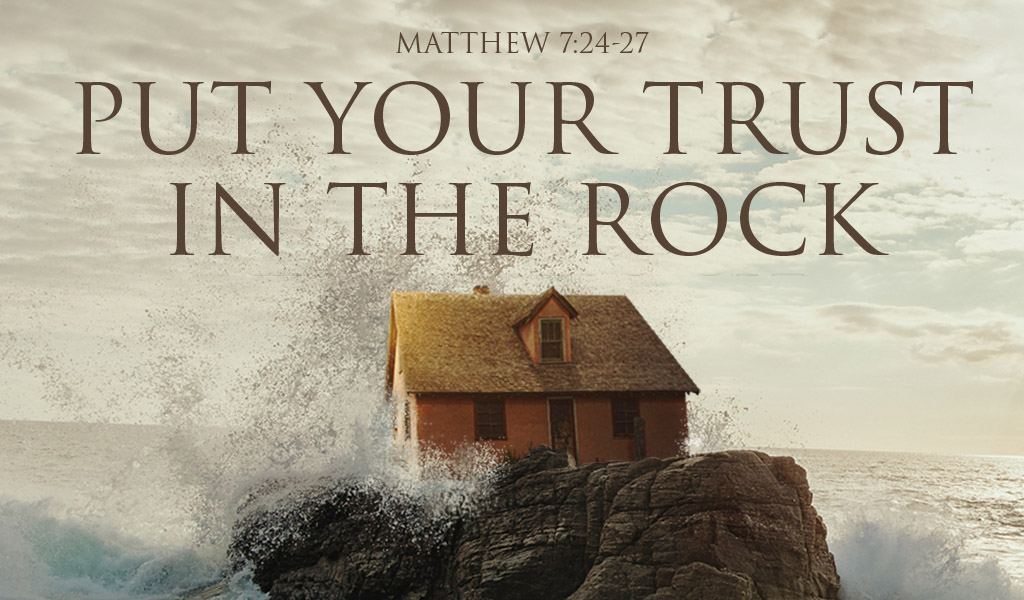
Matthew 7:24-27 (NIV)
“Therefore everyone who hears these words of mine and puts them into practice is like a wise man who built his house on the rock. The rain came down, the streams rose, and the winds blew and beat against that house; yet it did not fall, because it had its foundation on the rock. But everyone who hears these words of mine and does not put them into practice is like a foolish man who built his house on sand. The rain came down, the streams rose, and the winds blew and beat against that house, and it fell with a great crash.”
Luke 6:46-49 (NIV)
“Why do you call me, ‘Lord, Lord,’ and do not do what I say? As for everyone who comes to me and hears my words and puts them into practice, I will show you what they are like. They are like a man building a house, who dug down deep and laid the foundation on rock. When a flood came, the torrent struck that house but could not shake it, because it was well built. But the one who hears my words and does not put them into practice is like a man who built a house on the ground without a foundation. The moment the torrent struck that house, it collapsed and its destruction was complete.”
John 14:17 (NIV)
“If you love me, keep my commands."
1 Samuel 15:19-22 (NIV)
"'Why did you not obey the Lord? Why did you pounce on the plunder and do evil in the eyes of the Lord?' 'But I did obey the Lord,' Saul said. 'I went on the mission the Lord assigned me. I completely destroyed the Amalekites and brought back Agag their king. The soldiers took sheep and cattle from the plunder, the best of what was devoted to God, in order to sacrifice them to the Lord your God at Gilgal.'
But Samuel replied:
'Does the Lord delight in burnt offerings and sacrifices as much as in obeying the Lord? To obey is better than sacrifice, and to heed is better than the fat of rams.'"
Proverbs 11:28 (NIV)
“Those who trust in their riches will fall, but the righteous will thrive like a green leaf."
Proverbs 28:26 (NIV)
“Those who trust in themselves are fools, but those who walk in wisdom are kept safe."
Isaiah 47:10 (NIV)
"You have trusted in your wickedness and have said, ‘No one sees me.’ Your wisdom and knowledge mislead you when you say to yourself, ‘I am, and there is none besides me.’"
Isaiah 28:15-16 (NIV)
“You boast, 'We have entered into a covenant with death, with the realm of the dead we have made an agreement. When an overwhelming scourge sweeps by, it cannot touch us, for we have made a lie our refuge and falsehood our hiding place.'
So this is what the Sovereign Lord says:
'See, I lay a stone in Zion, a tested stone, a precious cornerstone for a sure foundation; the one who relies on it will never be stricken with panic.'"
Jeremiah 17:15 (NIV)
"This is what the Lord says:
'Cursed is the one who trusts in man, who draws strength from mere flesh and whose heart turns away from the Lord.'"
Jeremiah 17:7 (NIV)
“But blessed is the one who trusts in the Lord, whose confidence is in him."
Jeremiah 17:9-10 (NIV)
“The heart is deceitful above all things and beyond cure. Who can understand it? 'I the Lord search the heart and examine the mind, to reward each person according to their conduct, according to what their deeds deserve.'”
Sermon Text
Put Your Trust in the Rock
Sermon preached by Ronald Ayala Iglesia Fe Unida - (United Faith Church in Nueva Suyapa, Honduras)
Those of us here, every person, every Christian around the world, will experience problems and circumstances in our lives - “storms” as the Bible often calls them. We will all go through them at some point in our lives. And we have been talking these past few weeks about the power of the Gospel. The Word has come to teach us, to instruct us, to take us out - out of our comfort zone or as we would call it - our complacency, right? Because many of us, many people who have been in the Gospel for a long time, we often believe that the path we are on is the right one, but the right path is laid out in the Word of the Lord, and the Gospel is described in the Word of the Lord, and the way we are to live is laid out in the Word of the Lord. Not in what I think or what I believe it should be. So today, we are going to look at a parable that the Lord told His disciples and all those who were following Him.
"The Word has come to teach us, to instruct us, to take us out - out of our comfort zone or as we would call it our complacency… "
Go to Matthew 7:24. It's a fairly well-known story. Matthew chapter 7, verse 24. We're going to see in this story, which we all know, how Jesus speaks to His disciples to teach them, to continue teaching them what Christianity is, what the true gospel is, because all these people were accustomed to the law, to the Word of God in a certain way. And Jesus comes to speak of the kingdom of God. He began to preach and tell them, "Repent, for the kingdom of heaven is at hand." Now, all these people to whom Jesus is preaching knew the Word; they all knew the Bible. So, in Matthew 7, verses 24-27, Jesus tells the parable of the wise and the foolish builder: "Therefore everyone who hears these words of mine and puts them into practice is like a wise man." The Lord is trying to use a parable to illustrate a biblical truth, so that we can understand it in a simple way. So, He is saying, “Well, the true Christian is like this... a wise man built his house on the rock. The rain came down, the streams rose, and the winds blew and beat against that house, yet it did not fall because it had its foundation on the rock. But everyone who hears these words of mine and does not put them into practice is like a foolish man who built his house on sand. The rain came down, the streams rose, and the winds blew and beat against that house, and it fell with a great crash.”
I want us to read the parallel text to this in Luke chapter 6 because it has an important nuance, a difference at the beginning. Luke 6:46—all the verses are right here in front of you - Luke chapter 6, verse 46 onward says, “Why do you call me, ‘Lord, Lord,’ and do not do what I tell you? I will tell you what everyone who comes to me and hears my words and puts into practice is like: They are like a man building a house, who dug down deep and laid the foundation on rock. When a flood came, the torrent struck that house but could not shake it, because it was well built.”
Why was the house well built? Because they had dug deep. But the one who hears My words—I'm not saying the one who leaves, or the one who doesn't hear, or the one in the street, or the one outside—no, the one who hears My words and doesn't put them into practice, is like a man who built his house on the ground without a foundation. As soon as the torrent struck it, the house collapsed, and the disaster was terrible.
Many people followed Jesus at this point. In fact, this is the end of the Sermon on the Mount; there were so many people there with Him. They followed Him throughout His ministry. They came to hear Him from all over. Some came to hear His message, others came seeking healing, miracles, deliverance, and many people followed Him. But He realized something at that moment - many people who came to Him and heard His message returned home, and even then, they continued with their lives the same way. There was no change. Why? Because they said, "You don't practice what you say." But that wasn’t the case. Jesus, we know from the Bible that He was a carpenter like Joseph, and as a carpenter in those times, I believe He was a house builder because in those days houses were built of wood. So Jesus knew exactly what He was talking about when He spoke of construction. He knew what He was talking about; He knew that you have to dig deep to build a house, that you have to lay a foundation.
How many of us know that? Building a house isn't just about putting up walls; you have to dig into the ground to lay a foundation, a thick footing underneath, right? And all of that depends on the soil, because it's not the same building on hard ground as on soft ground, is it? We've been there. Do you remember what it was like here before? Those of you who have been here awhile remember it was rock, right? Do you remember? It was rock here, so we didn't have to dig as deep as in other places, where it's just sand. You can't build a house there because the sand shifts and eventually the house will collapse. So, if you're going to build on soft ground, you have to dig very, very, very deep until you find that spot where you can lay a firm foundation. But imagine if we didn't know that, if we didn't know we had to do that, or if we hired an engineer or an architect who wasn't paying attention in class that day, in the soil science class. What do you think happens? He gets there to build his house, but he didn't pay attention in class that day. What would happen to that construction? If this person didn't pay attention or if we aren't attentive?
Sometimes it happens to us, right? That if you're not paying attention to things here in this life - they tell you, “Go somewhere, to the market to buy something,” and they say, "Give me 10 tomatoes," you say, "Oh, yes," and they make a mistake and add a tomato, and you think, "Why didn't I notice?" Because you're not paying attention. Because you have to be attentive to things. Education experts say that in Latin America we have a very serious attention problem because we aren't taught to listen. Attention comes from being taught to hear, to pay attention. We haven’t been trained for it. And do you know where the training to pay attention begins? According to education experts, reading begins with learning to read, and reading constantly develops attention. That's why, according to statistics, children between 12 and 18 years old in Europe read around 150 books. I read a very recent statistic that in Spain, children between 10 and 13 years old read an average of 7 to 8 books a year. Ten-year-olds are reading 7 or 8 books a year. Why? To develop attention, to be able to concentrate. So, experts say, in Latin America we have a serious problem: we don't pay attention because we haven't been trained to listen. And you know what? It's necessary to pay attention, it's necessary to be attentive. Many times there are distractions, there are things you can't prevent from happening. For example, in church, or when you're reading the Bible at home at night, you can't stop your neighbor from playing music at full volume or whatever they want. But there are other things you can control. You can be determined to come to the Lord's house, to listen and pay attention, not be thinking about the beans you left cooking, the pot on the stove over there, or what you have to do tomorrow or in the afternoon when you leave here. You need to come here and say, "Today I'm going to pay attention to what the pastor is saying, not whoever is over there.” But then the pastor says, "Brother, let's look at Luke.” And you think, “What did he say?” Because we're not paying attention.
Let’s look at Luke 6, verse 47. I'm going to tell you why paying attention is critical. Three things: 1) “Whoever comes to me.” We have already come to the Lord, yes? 2) For all the people who come, “whoever hears my words”, we need to fulfill the second criteria. This message, though, is about the third criteria in Christ’s instruction. Sometimes we don't even fulfill the second, and that’s a problem. But what is Christ’s third criteria? 3) “Put them into practice.” In order to be able to obey, we need to pay attention. You can't obey someone you don’t listen to, you can't obey orders that you don't understand, that you don't know, right?
Think about it: sometimes the service ends, and by Monday morning everyone is asking me, "When is the next meeting?" They weren't tuned in. It’s like those smart stoves you can program to start at noon—if you aren't paying attention to the timer, you’ll suddenly think, "I have to run! My food is going to burn! I left it on the stove and it’s heating up all by itself!" We must pay attention to everything in life, but especially to the Word of the Lord. We have to be attentive to what He is saying while we are praying. We’ve always been taught to talk, talk, talk—to just give God a list—but we never stop to listen. We need to be quiet. We need to be attentive to the voice of the Lord.
"We have always been taught to talk, talk, talk, and we do not pay attention to what the Lord is saying. We need to pay attention; we need to be attentive to the voice of the Lord."
We have a serious problem in our culture, in our country, where people don't pay attention. That's why politicians take advantage of us, that's why they do whatever they want in this country, because nobody pays attention to what's happening. Everyone is caught up in their own problems, in all their own affairs. But it's time to learn to pay attention to the voice of the Lord, to the Word of the Lord, so that we can obey the Word of the Lord. We have to listen to it, we have to meditate on it, we have to say, "Lord, speak to me," and for a moment, stop. Stop everything else, everything we're doing, and let the Lord speak to our hearts. We've been talking about obedience these past few weeks because that's what the gospel is about, but it's difficult if we can't pay attention. Christ is talking about two kinds of people here, people who are very similar because they are both listening. They are both there listening to Him, and they both have a purpose and a goal, which is to build a house, and they both do it. They both strive, they both build, they both raise. It's not that one is lazy... No. It’s not that one is wicked and one is a sinner, no. There's something that differentiates them though, and it says that one is—in Matthew, what word does it use?—one is prudent and the other is foolish. In another version, it says one is foolish and the other is wise. The word "prudent" there means foresighted, considerate, careful, someone who pays attention to what they do. What does "prepared" mean? Someone who pays attention or thinks about what will happen next, right? Some of us get paid and they give us $50, and we're walking down the street with the $50, and there's a sale: a hamburger that used to cost $13, but today it's $10, and we say, "Today's my day, today's my day, I deserve it, I'll buy it." And we buy the hamburger and keep the $37, the $40. And after we've eaten it, we remember that those $50 were for the whole week, for bus fare, and now we'll have to walk to work. Why? Oh! I forgot to ask, am I capable of that? Of course we are! And that's just the bare minimum, because in life, things happen so often. Things come into our lives and we don't think, "What will happen next? If I do this, what will happen afterward? If I get involved in this, what will happen afterward?" That's being foresighted.
Therefore, the foolish person is the opposite, the one who isn't foresighted, the one who is foolish. In fact, the most accurate translation of this word is "foolish," someone who is careless, who doesn't pay attention to what they're doing. "Oh, I'm going to do this," and tomorrow they'll be left without food, and tomorrow, “well, I don't know, God will decide, right? God will decide.” So, how foolish, how foolish. Then the Lord is saying there's something that distinguishes these two people: one is looking ahead to what might happen in the future.
Going back to the story, I want you to imagine for a moment building a house in the Israeli desert. Can you imagine what it's like to build there? If you look it up, in Israel there are approximately 5 to 7 months of summer, more or less, and 5 months of winter. Autumn and spring are quite short, but let's say 5 months of summer and 5 months of winter. In the winter there, you can't build; it's impossible to build because of the rains since they're in the desert. So people have to take advantage of the summer to build. Now, imagine building in the desert summer, it’s 104 degrees Fahrenheit in those places, and you’re digging. So these two people say, "Let's build," and they go and start digging. And look at the sun here, when making those foundations, making those holes; it isn't going to take them a day. It's not going to be a day because they have to go deeper. They say they have to dig until they reach rock, until they find firm ground. So probably one of them said, "No way, I don't know if this is worth it to be honest. Look at this sun, and this ground is hard anyway." And so he starts to build the walls and lays one row of adobe bricks, then another, and it doesn't weigh too much as he's laying it; it doesn't move. It seems to be working fine. He looks at the other man digging. "I'm already building my walls," he says, and he continues to build. He builds and raises his little house. Of course, it didn't take him two days to build his little house either; it took time and effort. He raises his walls and takes his family to the little house, while the other man keeps digging, digging, digging. While this man is already singing hymns in his house, giving thanks to the Lord for the little house and everything he has, the other man keeps digging, digging, digging deeper.
I don't know if the sand house, the one built on sand, could even be bigger and more luxurious, since it took less time, or less effort, and less money to dig. I don't know, but what I do know is that it took effort. We're not going to say that the house built on sand didn't require effort because that's not true. The man who built on the sand also exerted himself a bit. Build your house, but when it comes to construction, it's not just about putting up a house to live in; it's about building it well so that those walls don't collapse on you in the future, right? It doesn't make sense if you spend your savings on walls that won't last, and all your savings, all your dreams, all your hopes, all your aspirations, all your little house, and this and that, and October comes, and while we're celebrating the holidays, our friend's house is falling down. Why? Because we weren't prudent. We have to be cautious when building.
Jesus is saying that there are many who strive in vain because they don't live what they hear; that's a wasted effort. They don't practice the Word, and He's saying that a life like that, sooner or later, will fail. The Lord is telling us, “I know you strive, I know you have tried, I know you have built things, but unless you practice the Word, sooner or later, you will fail.” Not only in our lives, because this parable speaks of many things, mainly the moment when you and I will stand before God to give an account.
That is why in Matthew 7:21, the Lord told them, "Not everyone who says to me, 'Lord, Lord,' will enter the kingdom of heaven, but only the one who does the will of my Father who is in heaven, the one who obeys me. I do not know the others, because they have done what they wanted, what they thought." So, what is Jesus saying? He is saying, the foundation of our lives is Christ. You have to dig deep until you find the rock. The rock is Christ Jesus, the rock is the Word of God. Christ Jesus said, “I am the truth.” John describes Jesus and says, “the Word was with God and the Word was God.” Christ Jesus is the Word and that is our foundation. Then Christ says, “whoever practices these words, then storms will come, difficulties will come and many things will happen, but what is His, will not collapse.” This parable is told at the end of the Sermon on the Mount. The Sermon on the Mount is a teaching where Jesus is giving the disciples the new standard of morality, of His teaching of what they have to do as His followers.
In that sermon, Jesus told the disciples, "You have heard that they said 'an eye for an eye and a tooth for a tooth,' but I tell you, if you have an enemy, love your enemies, and not only that, forgive them and pray for them.” That is, if someone—you have heard this—but I tell you that if someone strikes you on one cheek, offer them the other." And the Lord begins to speak to them about the things in life, about what He expects from His followers. Then He looks at the people at the end and tells them, "But one thing I tell you, you have to practice it. It is not enough to hear the Word and say, 'Wow, that was a good sermon,' or 'Wow, Jesus, that was a good word,' as these people were saying, right?" They were impressed and said, "What authority this teacher speaks with! What authority this man has!" And they went home and continued living the same way. It's not enough to just hear the Word, it's not enough to come to church and practice some Christian things. We have to practice the Word of the Lord out there, when we're at home, when we're with our families. If I don't do that, I'm like the fool who builds on sand. If I can't forgive, Jesus is telling you, "Forgive your enemy, forgive the one who wrongs you, forgive the one who hurts you, love them and pray for them." That's the Word of God. Do you understand that’s the gospel? That's more important than coming to church and raising your hands and jumping around. Forgive in the heart, because if I don't forgive, sooner or later my relationships will fail. That's building on sand. If I can't forgive my brothers and sisters, the people who hurt me, sooner or later my relationships will fail. And that's what Jesus is saying: you build them, and we all build something in life, we all do. We build personal relationships with our father, with our children, with our husbands, with our wives, with our brothers and sisters. We build a ministry. We walk in this life.
The Word of the Lord tells us not to steal, and if I'm stealing at my job, what will I do? One day they'll catch me and fire me, and my world will fall apart because I trusted in my work and what I earned from it. But the Word says that one day, if I don't fulfill what's in the Word, that it will all fall apart. What I'm building will fall apart and the loss will be immense, it will be great when we least expect it. Oh, because what's happening with this, and what's happening with what was here, in my family, at my job, in the church, and this and that? Because we're only doing what we think is right, but not what the Lord has commanded us. We need to decide what material our house, our life, will be built with. Everything we do requires determination because it won't happen overnight, but we need determination.
" Everything we do requires determination because it won't happen overnight, but we need determination."
There are many examples of this in the Bible. We have the prophet Daniel. He arrived in Babylon, a place where he was offered everything. He was offered a good job in exchange for what? In exchange for submitting to the customs and religion of that place. There in Babylon, in the palace, there was food, there was drink, there were women, there was everything. And he was going to work as a high-ranking official, but he decided—he resolved in his heart, and the Bible says, “he resolved in his heart not to defile himself.” And it wasn't easy; it wasn't done overnight. He was constantly tested, but the Lord honored him because Daniel decided to honor the Lord. So the Lord raised him up because he resolved in his heart, saying, "I'm going to do it."
We have to be determined to pray, to believe in what the Lord is going to do. On Thursday, we were asking the Lord for more; we were praying, right? Because we all need more, as the Bible says, "Let the one who lacks wisdom ask for it." But James says in the same text, "But to the one who doubts, He will give nothing." Why the doubting? Once yes, once no.
Who here needs wisdom? For everything, those little kids over there don't come with a manual, they don't come with instructions, but it's full of wisdom here in the Word, it's right here. You have to ask the Lord for it, you have to ask, and as James says, you have to ask constantly with determination, with faith, believing that God can do it. And for some reason, we believe that the Gospel should conform to the way I think it should be or the way I want it to be. Many people have that idea, convinced that the Gospel is a certain way.
I once had a conversation with someone facing a very serious problem. The Lord had already told him exactly what he needed to do to solve it, but the problem remained. He was telling me, "You know, I don't know how to do it. It just won't be solved. I don't know where to start." But then he paused and said, "You know what? I love God. [He puffed out his chest] I love God. If ever God is here, God is there, I love Him and when I am in His presence He has already done it. But had he done what God told him to do? No. What does the Bible say about love? John 14:15, here I’ll read it quickly, don't look it up: John 14:15 “If you love me, you will obey my commands.”
So we might think we love God because of this, because of that, but the Lord says “it's not about believing you love Me, it's not about thinking you love Me.” He already revealed how to know we love Him, "If you love Me, obey My Word." That's how you show love for God. You can show love to people however you want, however you've thought, however you've been taught, but that doesn't mean it's right. We've been taught a lot of incorrect things; we come from many traditions and we come from many pagan, worldly customs. But the truth is in the Word of God, and if I say I love God, I have to learn the Word. That's why He says, "Dig deep, dig deep, find the rock." And I say, "I love God, so I have to obey." And if I obey what He has commanded me, maybe then, the storm I'm going through won't destroy me. So how can we know if we are true followers of Christ? Because we obey.
1 Samuel chapter 15, verse 19. We know the story of Saul, right? 1 Samuel 15:19. “Why, then, did you not obey the Lord?” The prophet Samuel is saying, “Why did you pounce on the plunder and do evil in the eyes of the Lord?” Look at what Saul answers. “But I did obey the Lord” Saul insisted, “I went on the mission the Lord assigned me.” And what was the mission? Do you remember? To eliminate everyone. Everyone. And what did he do? He said, “I completely destroyed the Amalekites and brought back Agag their king. The soldiers took sheep and cattle from the plunder, the best of what was devoted to God, in order to sacrifice them to the Lord your God at Gilgal.” In verse 22 Samuel answered him, “Does the Lord delight in burnt offerings and sacrifices as much as obeying the Lord? To obey is better than sacrifice, and to heed is better than the fat of rams.”
Here, we see him stating the same conditions the Lord Jesus gives in the parable: pay attention and obey. I believe he did pay attention, but he refused to obey.
Everything had to be eliminated, but what led him to this failure? He decided to do what suited him. He said, "I’m going to take the best; I’m going to take what’s good; I’m going to take what is mine." How many times have you made decisions just like that?
We must realize something critical here. Some would argue, "But he didn't do anything wrong or sinful." Yet, he did the one thing that matters most: he disobeyed a direct command from God. The Word tells us he was rejected at that very moment for doing what he thought was right for himself. When we fail to obey, we open a door to the enemy—and he will take every advantage to do exactly what he wants to do in our lives.
You know, in the army, they train people. They train them and subject them to a lot of suffering, a lot of work, and they also insult them constantly, right? Isn't it true that when they're in the army they're insulted? And what do they do, the soldiers. Why? It has a purpose. It's not because they're bad people. It has a purpose: to train people, to train and build character, to build the character of soldiers so they can learn to follow orders even if they don't want to, orders even from people they don't like. Because if this soldier doesn't learn to follow orders in difficult times, like in war, and the soldier says, "Why man? I'm not going there, let that other guy go," you can imagine, and the other one is already there, and they're saying, "You go then, you go." That doesn't happen in the army, does it? An order is given and it's obeyed. They have to be trained to follow orders in difficult times even if they don't want to, and sadly that doesn't happen in Christianity. When we're going through a difficult time, oh, oh, oh, how hard it is for us to follow orders and not argue. Some even dare to question what God is doing. We lack training, we lack the determination to follow orders. That's the Word of God: to follow orders, to follow the Word of the Lord, to obey the Word of the Lord. Trusting in ourselves is like building on sand. Trusting in what I can do, in my intelligence, in my abilities, in my work, in everything, in my family, in a person—all of that is building on sand. Why? Because one day, look, excuse me for saying this, but your parents might fail you someday, your partner might fail you someday, your job isn't forever—someday all of that will end, someday your best friend will betray you.
Have we had that kind of character? How many people are there that have the kind of temper where when anything happens—"Oh, oh, oh, oh"—and it's all over. Their world falls apart, they lose their jobs. How many people? In Asia, in China, in all those countries, in Korea, the suicide rate is so high because of the social pressure. If someone lets them down, if they lose their job, they feel worthless. What good has all their hard work in life earned them? And that's what I'm trying to say, brother. We work so hard in life to get what we want, to have our families, to have our children, and then one day something happens, and we say, "My God, what happened here?" Everything’s gone. I used to think, "Lord, I went to church, I sang hymns, I sent my son to Sunday school. What happened there?" And the Lord is telling us that the prudent person considers what will happen later with what they are doing right now. I don't know why my brothers have distanced themselves from me, abandoned me—and yet, I am the kind of person who never gives a hug, who never strives to see what we are building for the future. The Lord says you are striving in vain if you do things your way, in what your father taught you, what your mother taught you, what you learned from that lady over there, from the traditions and rituals you celebrate—that's where we all come from, yes, generations of traditions, right? Traditions that we do at home, that's where we come from. We are striving in vain.
I quickly looked at a couple of verses. Proverbs 11:28 “Those who trust in their riches will fall, but the righteous will thrive like a green leaf.” Proverbs 28:26 “Those who trust in themselves are fools, but those who walk in wisdom are kept safe.” Isaiah 47:10, You have trusted in your wickedness and have said, ‘No one sees me.’ Your wisdom and knowledge mislead you when you say to yourself, ‘I am, and there is none besides me.’” It is that many times we put our trust in other things. Isaiah 28:15-16, “You boast, “We have entered into a covenant with death, with the realm of the dead we have made an agreement. When an overwhelming scourge sweeps by, it cannot touch us, for we have made a lie our refuge and falsehood our hiding place.” So this is what the Sovereign Lord says: “See, I lay a stone in Zion, a tested stone, a precious cornerstone for a sure foundation; the one who relies on it will never be stricken with panic.” In another version it says, “he who believes.” He who believes will not be disoriented, he who believes will remain firm, he who trusts in that Rock. But if we are trusting, look, nobody says this, nobody says, "I trust in lies," "I trust in work," nobody says that, but it is our actions that demonstrate it. The Word says that faith without works is dead. We have faith, so we act because we have faith. If I say that I trust in God, then that is demonstrated, it is demonstrated. If I say that I love my brother, that is demonstrated. If I say that I forgive my brother, someone has to see it.
On Thursday we were talking about that, that Jesus said, "Jesus saw the faith of those men who were carrying the paralytic." Jesus saw the faith - not because He is more spiritual, not because He saw inside, but because of what they were doing. God can see, people can see that you and I trust in Him. People can see that we are trusting in God by our actions. Jeremiah chapter 17:5, “Thus says the Lord: ‘Cursed is the one who trusts in man, who draws strength from mere flesh and whose heart turns away from the Lord.” I want you to notice something interesting here. In the Bible, numbers are very important, and when the Lord presents two options, He speaks of complete things. He speaks of things that you and I have to consider. For example, in the Bible it's black and white; there's no gray area. It's yes or no; there's no maybe, right? The Lord in Revelations tells the church that it has to be either cold or hot, not lukewarm. There are two options. Today, we're talking about the wise and the foolish; there's no middle ground. We're either here or we're there. And here it says, "Cursed is the man who trusts in man." No, don't trust in man; trust in God. Because if you don't trust in God, you trust in man, or as the verse below says, in your own strength, in what you do, in what my parents can do, in what my job can do, in what my money can do. And when all that falls apart, what will happen to me?
Look at Jeremiah 17:7: "Blessed is the one who trusts in the Lord, whose confidence is in Him." Blessed is the man who trusts in the Lord. There is blessing when we put our trust in God. That’s the Lord's promise: that even if the storm comes, even if the winds blow, it will not collapse; we will remain standing. The Word isn't saying that we're going to hide from the storm, but that we're going to remain despite the storm.
He who digs deep—that's what's interesting about the parable. The storm came to both of them; they both suffered the same storm on the same day. And I don't know if those inside the house were trembling with fear, but you know, even though they were trembling, or something in their hearts was saying, "Wow, what a storm!"— those in the other house were picking up the pieces of their house.
Jesus looks into the eyes of these people and says, "I want to spare you a great disaster. I want to spare you from wasting your time, from building in vain, from growing old and seeing your life destroyed, and seeing that everything you did, that nothing remains; there is no fruit for God. Everything you built in your life was in vain." It's pointless. I want to spare all those who hear the Word of God from this. "Trust in me," says the Lord. "Put your trust in me."
And what does it mean to put your trust in God? Practice what I've told you. I know it's not easy; it's like digging a deep hole. That's how difficult it is. That's how difficult it is to get home and ask for forgiveness. But trust in Me, do it, and you'll see that your house won't fall down. Because if you have the capacity to ask for forgiveness, difficulties will come, but that house will remain standing. What will bring it down? When you see a difficult problem? When you're being offered something immoral? But when you're trusting in My Word, I will sustain you. Lord, I will not give in to the things of this world, to the offers, to the things that are not right. They are threatening to fire me, they are threatening me with this, but I trust in You, Lord. I know that if I am righteous, Father, You will sustain me.
That is putting your trust in the Lord and obeying His Word; then you will not fall. How many people get into politics and make shady deals? And they sell their morals, and they sell their values, and their lives are destroyed sooner or later—destroyed when we don't pay attention to the important things? The man who built on the sand wasn't paying attention to something important. Many of us believe that what is important in life is money, making money and having things, and giving material things to our children and our family, and we forget that it is more important to show love for God.
That’s building on sand. It doesn't matter how many toys I buy my daughter; it doesn't matter how much I have in the bank so that when I die, she'll be secure. That doesn't matter. What matters is the time I spend with her and what I teach her, so that when the bad days come—because they will—she'll be a teenager, and I'll have to deal with it like everyone else. The question is whether we've dug deep or not, whether we've trusted in the Lord.
It doesn't matter; today, people are afraid of having children, wondering how we can raise a child in this horrible society, with so much darkness. But you know, we've put our trust in the Rock, and that Rock won't fail us. I put my family's trust in the Rock, in the Word of the Lord, and no matter how much darkness is out there, my house won't fall. Your house won't fall if you trust in the Rock; your house won't fall, your family won't fall.
But trust, trust in the Word. Turn off the television and pick up the Bible with your children. That's trusting in the Rock; that's digging deep, it's not about the phone. Give them a hug, play with them for a little while. Let's not give in to the pressure to live as the world does, saying - “You don't know how much energy comes out of me, how tired I am!” Take vitamins then; take fish oil! Dig deep; go deep, go deep. The Lord doesn't disappoint anyone. Everyone who builds their life on Christ is not disappointed, and the storm will come, but they will not be brought down.
"Everyone who builds their life on Christ is not disappointed, and the storm will come, but they will not be brought down."
Jeremiah 17:9: “The heart is deceitful above all things and beyond cure. Who can understand it?” “I think I'm doing it right, Lord; I think it's okay this way.” But when we go to the Word, that's where we realize if we're really doing it right. The Word is the mirror that tells us: "No, not that way, that's not the place, that's not the path, that's not the way." “I think I have to do it this way, okay brother?”
Today is the day; today is the day. If you listen to the voice of the Lord, the Word says, "Do not harden your heart." Today is the day. It doesn't matter if I've believed I've been doing it right, but in the light of the Word, we can say, "Lord, my heart believes I've been doing it right, but teach me Your ways, teach me Your way, Lord."
Look at Jeremiah 17:10. I want to end with this: "I, the Lord, search the heart and examine the mind, to reward each person according to their conduct, according to what their deeds deserve." He is the one who searches the heart; He is the one who knows our ways. Many times we believe we are doing well, that we are building well, but this is a time to analyze, to reflect on how we are building our lives, on what we are building.
Today is a day for us to say to the Lord, "Search me, examine me," and ask the Lord for forgiveness for not trusting in Him. To disobey is to not trust in His Word. May the Lord show us today where our home truly is. Put your trust in the Lord, and He will not disappoint you.