
Do It and You Will Live
Ronald Ayala
Home
Sermons - Fe Unida
Luke 10:25-27 (NIV)
On one occasion an expert in the law stood up to test Jesus. “Teacher,” he asked, “what must I do to inherit eternal life?”
“What is written in the Law?” he replied. “How do you read it?”
He answered, “‘Love the Lord your God with all your heart and with all your soul and with all your strength and with all your mind’; and, ‘Love your neighbor as yourself.’”
“You have answered correctly,” Jesus replied. “Do this and you will live.”
But he wanted to justify himself, so he asked Jesus, “And who is my neighbor?”
In reply Jesus said: “A man was going down from Jerusalem to Jericho, when he was attacked by robbers. They stripped him of his clothes, beat him and went away, leaving him half dead. A priest happened to be going down the same road, and when he saw the man, he passed by on the other side. So too, a Levite, when he came to the place and saw him, passed by on the other side. But a Samaritan, as he traveled, came where the man was; and when he saw him, he took pity on him. He went to him and bandaged his wounds, pouring on oil and wine. Then he put the man on his own donkey, brought him to an inn and took care of him. The next day he took out two denarii and gave them to the innkeeper. ‘Look after him,’ he said, ‘and when I return, I will reimburse you for any extra expense you may have.’
“Which of these three do you think was a neighbor to the man who fell into the hands of robbers?”
The expert in the law replied, “The one who had mercy on him.”
Jesus told him, “Go and do likewise.”
James 1:22 (NIV)
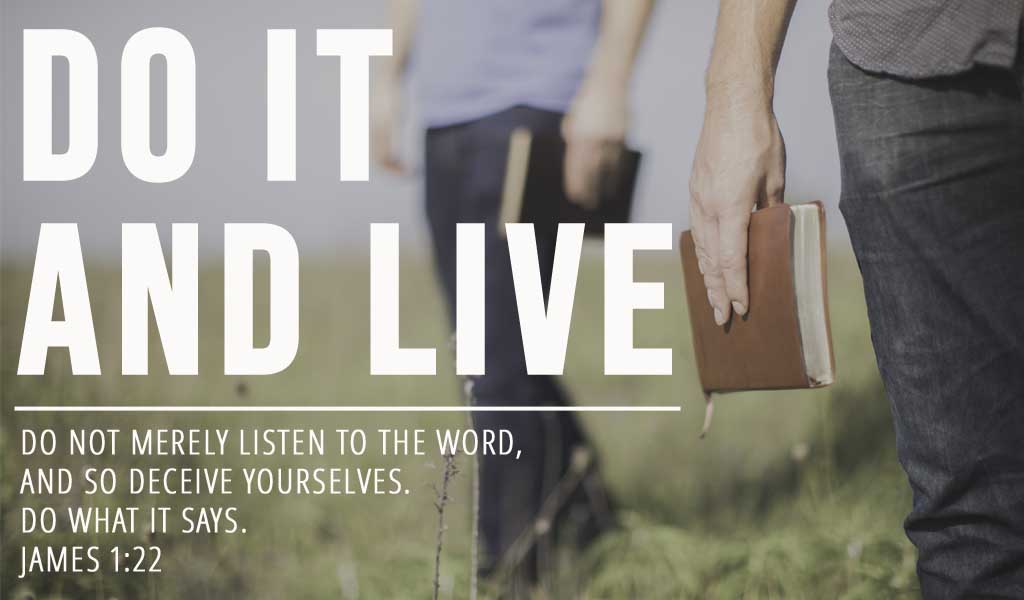
Do not merely listen to the word, and so deceive yourselves. Do what it says.
1 John 4:20-21 (NIV)
Whoever claims to love God yet hates a brother or sister is a liar. For whoever does not love their brother and sister, whom they have seen, cannot love God, whom they have not seen. And he has given us this command: Anyone who loves God must also love their brother and sister.
Deuteronomy 30:19-20 (NIV)
This day I call the heavens and the earth as witnesses against you that I have set before you life and death, blessings and curses. Now choose life, so that you and your children may live and that you may love the Lord your God, listen to his voice, and hold fast to him. For the Lord is your life, and he will give you many years in the land he swore to give to your fathers, Abraham, Isaac and Jacob.
Sermon Text
Do It and You Will Live
Sermon preached by Ronald Ayala - Iglesia Fe Unida (United Faith Church in Nueva Suyapa, Honduras)
May God bless you all. Truly, the Lord is good. Welcome to the house of the Lord! We give thanks to Him because His presence is in this place—He is visiting us today. God bless you; it is so good to be in the house of the Lord, amen? Do you know why? Because He is coming soon. The King is coming soon; our Beloved is on His way! How many of you know this? The Lord is near, and His church is waiting for Him. As we have been learning, we are waiting for Him and preparing to meet Him, just as a bride prepares for her special day—for her wedding day.
But you know what? For many reasons, we often believe we are on the right path—that we are preparing well for that day. But as the Word has been teaching us, we need to believe in it; we must believe in the power of the Word and be diligent in examining our walk by it. We have to ask ourselves: Are we truly on the right path—the path of the Lord—and not just one that I think is right?
It is so important that you and I understand that. As the Bible says, there are many paths that seem right to a person, but their end is death. So, we must come to the Bible, examine ourselves against it, and be able to say, "Okay, yes, I am on the Lord's path."
I want us to turn to Luke chapter 10 today—Luke chapter 10. We are going to use this passage to examine our lives, to see if we are indeed on the right path, or if we have gone astray only to find ourselves saying, "Wow, this isn't the way."
Let’s look at Luke chapter 10, verse 25 and onward. We all know the parable of the Good Samaritan. I’m going to read it from the NIV: “On one occasion an expert in the law stood up to test Jesus. ‘Teacher,’ he asked, ‘what must I do to inherit eternal life?’ ‘What is written in the Law?’ He replied. ‘How do you read it?’ He answered, ‘Love the Lord your God with all your heart and with all your soul and with all your strength and with all your mind’; and, ‘Love your neighbor as yourself.’ ‘You have answered correctly,’ Jesus replied. ‘Do this and you will live.’ But he wanted to justify himself, so he asked Jesus, ‘And who is my neighbor?’”
“In reply Jesus said: ‘A man was going down from Jerusalem to Jericho, when he was attacked by robbers. They stripped him of his clothes, beat him and went away, leaving him half dead. A priest happened to be going down the same road, and when he saw the man, he passed by on the other side. So too, a Levite, when he came to the place and saw him, passed by on the other side. But a Samaritan, as he traveled, came where the man was; and when he saw him, he took pity on him. He went to him and bandaged his wounds, pouring on oil and wine. Then he put the man on his own donkey, brought him to an inn and took care of him. The next day he took out two denarii and gave them to the innkeeper. “Look after him,” he said, “and when I return, I will reimburse you for any extra expense you may have.”
‘Which of these three do you think was a neighbor to the man who fell into the hands of robbers?’ The expert in the law replied, ‘The one who had mercy on him.’ Jesus told him, ‘Go and do likewise.’”
We know the story of the Good Samaritan, right? There are several characters that we need to analyze this morning. It says there was a teacher of the law who stood up to ask Jesus a question. Now, Jesus was teaching—and in those days, it was customary that when a rabbi taught, everyone remained seated. This man stands up to make a clarification—to ask a question so that everyone else can hear it.
This person was an expert. He was someone who knew a lot about the Bible and the law; he dedicated his life to studying it. Therefore, people assumed he lived according to the Word because his life was focused on it. But the Word says he actually wanted to trap Jesus. His question in verse 25 is: “Teacher, what must I do to inherit eternal life?”
What a great question! For centuries, mankind has wondered what we must do to inherit eternal life. You know, at one time, the Roman Catholic Church taught that we were justified by works—that we had to do good to inherit heaven. That was years ago, but some in the church still think that way. On the other hand, many modern churches now say, “Once saved, always saved,” right? Saved by grace—but with the idea that you can do whatever you want and still be saved.
So people today are still asking: “How can I be saved? How can I inherit eternal life?” In fact, if we were to ask that right now in the church, many people wouldn't know how to answer. How do we inherit eternal life?
This parable is not going to lead us to the conclusion that eternal life is earned by doing good to our brothers and sisters. Often, people read this story and say, “Oh, Jesus was just talking about being nice to your neighbor,” but that’s not it. Salvation isn’t earned by works. That is not what Jesus is saying. However, this passage is interesting because we often struggle to articulate the answer ourselves. Let’s see what the man who knew the Bible said.
The teacher answers by naming the first two commandments (which you can find in Deuteronomy 6:5 and Leviticus 19:18). He answers correctly: “Love the Lord your God with all your heart, soul, and strength, and love your neighbor as yourself.”
The man is told to keep these commandments. Now, the New Testament isn't telling us that eternal life is a reward for good works; that isn't the interpretation. The true importance of this passage is that, in a certain sense, the church today is a bit like this man. So, let’s see how we resemble him, and what Jesus wants to teach us about the path that is right to Him versus the path that seems right to us.
Thanks be to God, and blessed be the Lord, that He left us His Word! Because of it, you and I can correct our path today. We can look at our lives and say, "Wow, I thought I was right; I thought I was doing well and making an effort. But Lord, I see now that this isn't the way—the true way is this other one." And we are about to see exactly what that way is.
In verse 28, Jesus says to him, "You have answered correctly." Well answered, says Jesus. But then Jesus adds: "Do this and you will live." Wow. What does that really mean? What is Jesus telling him? He’s saying, "You aren't doing it." You know the verses, you know the theory, and you know the theology—but you don't practice it. Jesus was essentially telling him, "Since you know it, do it. Put it into practice, because right now, you aren't."
In James 1:22, it says: "Do not merely listen to the Word, and so deceive yourselves. Do what it says." We see this throughout the Bible. In Exodus 18, when God gave Moses the commandments, He said, "Here is the law; practice it and you will live." Jesus is simply reminding this man of that eternal truth: "Do it and you will live." James reminds us again in the New Testament: "Do not deceive yourselves."
"Don't be content, because that's deceiving yourself; hearing the Word and then not living it, not practicing it."
It’s not enough to just hear the Word. That’s what you’re doing, man of the law. You know many things. You’ve spent a lot of time there in the temple. You do many religious things there, but when you leave the temple and go home, you don't live it out. You don't put into practice everything you’ve heard. Don't be content, because that's deceiving yourself; hearing the Word and then not living it, not practicing it.
But you know what the issue is? I think many of us, many Christians, don't actually know how to do it. We often believe that the Word is meant to be practiced only here, within the four walls of the church. We think "freedom"—when we sing about being free—is just a feeling we have during a service, rather than something we carry out there into the world.
For many, the Word has been convicting lately because Jesus is so insistent on this point: Practice the Word. Think back to the example of the man who built on the rock versus the one who built on the sand. What was the difference? The one who builds on the rock is the one who not only hears the Word but puts it into practice. The one who builds on the sand hears it, but does nothing with it.
Both of these people are "workers." Both are striving, both are in the church, and both are busy doing things. But for one, everything crumbles, and for the other, it doesn't. Why? Because one is practicing the Word.
When the storms of life arrive, things often crumble. People may leave the church angry; some even renounce God and complain, "Why did this happen to me? Why did God let this happen?" But the Lord warned us beforehand: If you don't want it to fall apart, practice the Word. The storm will come, but the one who remains on the Rock—the one who digs deep and practices the Word—will live. Because the Word of God is life. Few truly understand that: The Word of God is life itself.
Do you know what that life feels like? It is breath. It is the strength that gets you up in the morning. It is life despite what is happening around you. If I am on the Rock, I won't fall. The storm will come, the water will rise, and the wind will blow, but the Word tells me I will not fall. I won't be the person crying out, "Lord, what happened?" No, I am going to stay on the Rock. The rain may keep coming, but I will remain standing. That is the promise of the Lord.
I know there is someone here today saying, "I want that." Many of us have tried the other way—building on the sand, ignoring the practice of the Word—and we watched everything fall apart. But today, the Lord invites us, as it says in the Psalms: "Taste and see that the Lord is good." Test Him! Put the Word into practice, and when the storm comes, you will remain firm.
The Lord was telling this man, "Do it. Go out into the street and live what you know; don't just talk about it." But look at verse 29. It says the man "wanted to justify himself." He tried to find a reason why he wasn't fulfilling the commandment, so he asked, "Well, who is my neighbor?"
He knows he isn’t fulfilling the command completely. You see, people often want to say, "I have a reason why I'm not fulfilling this commandment." Let me tell you quickly what was happening back then. For those who don't know, the Jews of that time were often taught only to help other Jews—to do good only to their own. Sometimes, that circle was even smaller, limited only to those closest to them. They were even known to refuse help to a non-Jewish woman in labor, saying, "We aren't going to help an ungodly person come into the world." Imagine reaching a point where you say “no” even to that! So, this man is justifying himself. "Well, Teacher," he asks, "Who is my neighbor?" He is interpreting the law to suit his own purposes.
It seems to me that sometimes, as Christians, we do the same; we want to interpret the Bible to suit our own purposes. This man makes two major mistakes. The first—and perhaps the biggest—was assuming he was already fulfilling the first commandment. He justifies himself on the second because he presumes he has mastered the first. And what is the first commandment? To love God "with all your heart, with all your soul, with all your strength, and with all your mind." He is telling Jesus, "Well, I fulfill this one."
But do we? That is a question for us today. Are we really fulfilling the first commandment? Remember the original question: How do we inherit the kingdom of heaven? It all boils down to these two commands. Do we truly love God in all those areas—heart, soul, strength, and mind? Let’s look at it through the lens of "praise" or "worship." When we are here, do we worship with all our mind? Do we listen to the Word with every part of our being?
To love Him is to love Him with our entire existence. Think about it in the simplest terms. Those of you who are married know this: you marry someone because you want to share your life. You want to share your decisions, your joys, and everything you have. You do it out of love, not for any other reason. You make decisions together; you do things together.
When we love God, we decide things with God. When we want to do something, we remember Him. Parents know this feeling. When a mother goes out to eat and is served a plate of food, what is she thinking? She thinks, "Oh, I’m going to save this little bit to take home to my child." She remembers them because they are in her heart. She doesn't forget! It’s not like going to the supermarket and having to remind yourself, "Oh, wait, I have a wife and a child; I should buy things for them." No one does that! You don't forget the people you love.
"To take God into account in your heart—that is love, not religiosity."
So, why do Christians forget God when they make a decision? How do we "forget" that we are Christians? We might say, "No one forgets God," but do we forget to take Him into account? To take God into account in your heart—that is love, not religiosity. It’s not something you do because you were told you have to. No one forgets they have a child or a spouse because they are carried in the heart. When you walk down the street, you should know the Lord is with you because He is in your heart. What a huge mistake this man made, believing he was already fulfilling that!
His second mistake was thinking he could fulfill the command to love God while failing to fulfill the second command to love his neighbor. First John 4:20-21 says: "If someone says 'I love God' but hates his brother, he is a liar." The Lord is saying, "Many of you go through life saying you love Me, but you do not love your brother." The Bible is clear: that is not the way. It is impossible to love God if you do not love your brother. Love is the way. That is the heart of the Gospel.
Jesus then uses a parable to show him who his neighbor really is. There are four characters: the wounded man on the road, and the three who pass by—a Priest, a Levite, and a Samaritan. Now, the Samaritan is key. The Samaritans were enemies of the Jews; they didn't speak to each other. This was shocking to the listeners! The Jews wouldn't even walk through Samaria; they would go all the way around it just to avoid them.
This story had a massive impact because the road from Jerusalem to Jericho was a real, dangerous place. What Jesus described could have happened to anyone. That’s the Gospel, brothers—it isn’t a mystery; it’s about everyday life. Two people pass by who represent the religious elite: the Priest and the Levite. If anyone should have helped, it was them! They should have been moved to compassion, but they weren't.
Why? I want us to pause here. Why didn't they help? We can think of many excuses. Maybe they were afraid—the road was dangerous. Maybe they thought, "It's a trap; if I stop, they'll jump me." Or, "I have to get to the temple; I can't be late for the service." Or even, "I don't know first aid; what can I do?" We might even say, "Well, he didn't ask for help; maybe he's just taking a nap."
As we saw in verse 29, the man "wanted to justify himself." We always have an excuse for why we do—or don't do—certain things. But the Word teaches us that what comes out of the mouth is what is already in the heart. Our actions reveal who we are. We like to say, "It just slipped out," but Jesus says it slipped out because it was already inside you.
I’ll give you an example. You know the traffic here in Honduras, right? I used to get so angry while driving—really angry! I could have said, "The traffic is a great excuse; anyone would react this way." But I had to ask myself, "Why am I reacting like this? Tomorrow I have to preach; people are watching." I realized the situation wasn't making me angry; it was just revealing the anxiety and stress already in my heart. The situation only reveals what is in the heart. It doesn't matter what they said to me or what they did; what is in the heart is what comes out in the moment of pressure.
"...the reaction one has doesn't depend on the situation, but on who someone is. Always on who that person is."
There are people who are insulted and respond with blows—they respond with violence. But another person responds to that same insult by staying silent, being indifferent, or turning away. You see, the reaction one has doesn't depend on the situation, but on who someone is. Always on who that person is. It is always about the character of the person.
That’s why it is so interesting when we are here in church, right? We talk about freedom and we talk about joy. We say, "I will praise You, Lord, because You have turned my sadness into joy!" But then we say, "Well, the truth is, life is so difficult. It’s always been this way, and that is why I’m not going to rejoice. I can’t, brother. You see, that’s just how I am." Then the music starts, and even if I’m happy, I think: How can you expect me to jump around with all the problems I have? But that very same night, that person goes out to have fun. Are we like that? Or aren't we?
We are what we are. I want you to understand this well: we are not only what we do here, and we are not only what we do there—we are everything. Whether we are hypocritical or fake, whether we deceive ourselves—as James says, that we "deceive ourselves"—that is the real issue. "I am what I am." If I am capable of jumping and shouting and insulting the opposing team because they scored a goal, what happens to me when I am here and I can't say anything? I can't do anything?
And it’s not just about soccer; it’s about everything you are passionate about—your work, your hobbies, your life. We’ve talked about this: are we disrespectful to our bosses? Do we disrespect our clients? No, we don't. But if we come into the house of the Lord and do that here—disrespect is disrespect. It’s like lying. No one thinks, "I’m a liar, and I’m going to lie right now." It just comes out because that’s who I am. I’m rebellious; I’m a liar. It’s just that I choose, for convenience, to insult a brother at church or disrespect an old man on the street, while staying silent in front of my boss.
That is not being a person of integrity. Integrity is being whole. It is being who we are in every situation. And the Lord is saying to that teacher of the law—and to us—"Friend, you are not whole. You are not practicing compassion or respect in every situation. You are picking and choosing."
For many, there is a desire to make excuses. "Others do it," or "The flesh is weak." Yes, but remember Joseph in the Bible? He was attacked by a woman who stripped him, and he ran away. So it’s not "everyone." When they were taken to Babylon, many young men sold themselves to the government just for a job. But Daniel and his friends said, "We are not going to participate in this. We are going to stand firm for our God." Everyone else was doing it, but they chose God. And the Lord rewarded them. The others never returned to Israel.
We have to stop with the excuses. We must come to the conclusion: "I did this." We should ask, "Lord, show me why I did it. Show me who I am." We deceive ourselves, but the Lord speaks the truth.
Why does this happen? There is a massive blindfold called religiosity. It tells people they are on the right path when they aren't. Why didn't those men stop to help? Because they considered their religious rituals more important than the Law of Love. They were busy with the liturgy—the prayer, the singing, the sermon. In our minds, Christianity often gets defined by that order of service. The priest likely thought, "I can't be late; I have to open the temple! I have to make the sacrifice!" The Levite likely thought, "I have to go sing. I have to teach at the children's church. How can I waste time helping here?"
But Jesus is exposing the reality: "Your heart. Your heart." They knew a lot, but they practiced nothing. Jesus tells us: "If you have something against someone, leave your offering at the altar. Go sort it out, then come back and praise." Let’s get our affairs in order. For many of us, the act of worship is more important than the heart of prayer. Do you pray at home? Do you study the Word at home? Or do you only read it when you have to teach a class or sing a song? What is more important: being in a service today, or having God’s guidance for your life? We fail because we don't practice what we know. That isn't a relationship.
We cling to earthly things. We say, "I’m a Christian—look at my Bible, look at my church attendance." But then we make life-altering decisions for our children without even consulting God. Or we insult people on the street because "nobody messes with me." We think we are empowered by the Word, but we are just clinging to our own pride. The Lord knows your heart, your thoughts, and the intentions behind every action. Are you truly preparing for His coming?
"The Word of God is power! It is transformation!"
The pandemic revealed the hearts of many. It revealed a belief that "if the church isn't open, I'm not a Christian." But Christianity isn't just about going into a building. The Word of God is power! It is transformation! We come here to be transformed into the image of God. The Gospel has the power to change a life—to not stay the same. Those old thoughts have to be kicked out!
Jesus said, "Repent. Seek the kingdom. Do something with your life." Do you know how hard it was for me to understand that? I thought I had life, but a man only truly begins to live when he comes to Christ and realizes he has nothing without Him. Then Christ fills him. That is the Gospel. In the middle of every problem, I have hope. Every morning I say, "Lord, thank You for another opportunity. I didn't come into this world for nothing. I am here to prepare myself, and if I see someone in need, I will help—because that is the Gospel."
Those priests didn't care because they only cared about the temple. But where was the love? Where was the service? We talk so much about compassion, but where is the practice? Jesus told the man, "You know what you have to do. Now do it." Because what he was doing wasn't love. The enemy wants to keep us blind, thinking that our religion will save us. But the question for us is: What are we going to do with the truth? Can we really stand before the Lord with an excuse?
I want to end with Deuteronomy 30:19: “Today I call heaven and earth to witness against you that I have set before you life and death, blessings and curses.” The Lord gives us a choice, and because He is so good, He whispers the answer: "Choose life!" Choose life so that you and your children may live. Love the Lord, obey Him, and be faithful—because your life depends on Him.
Friend, if the path you are on doesn't lead to eternal life, it isn't the way. It is much easier to preach or sing than it is to surrender your heart. Any of you could stand here and give a sermon. But which of us, when we leave this building, will say, "Lord, I carry You here in my heart and my mind. Every decision I make, I want You to be part of it"? That is fulfilling the Word. The Lord is good; even when we think we are right, He is faithful to make us reflect and turn back to Him.